
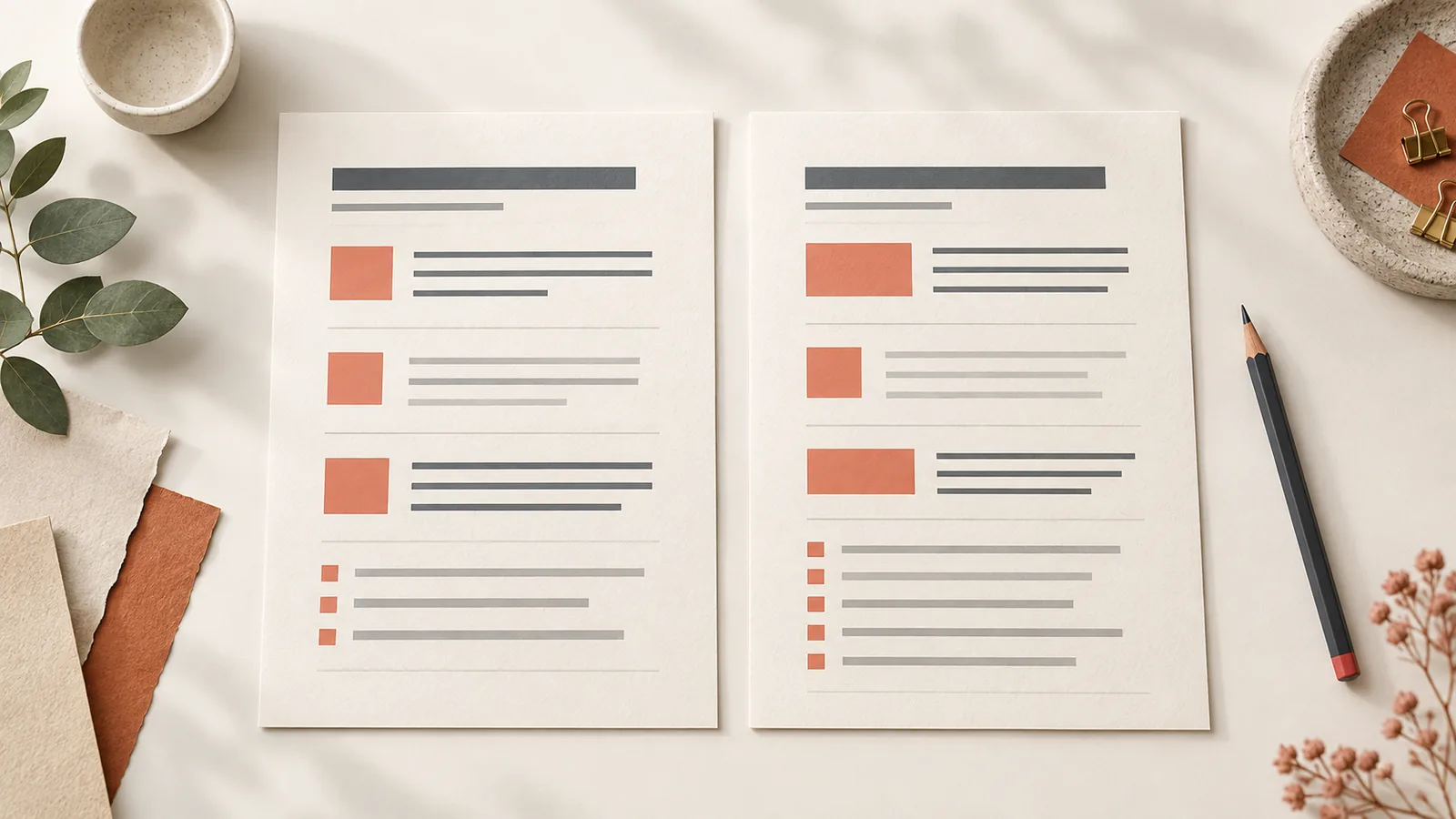
Two website proposals can promise a professional-looking site and still describe very different amounts of work. One might include writing the service pages. The other might leave every word to you. One might replace your existing site carefully. The other might price the new design without explaining what happens to the old pages.
The lower price is not automatically a problem, and the higher price is not automatically better. You need to know what each one will leave you with, what you will have to do yourself, and what you will keep paying after launch.
If you are comparing quotes for a service business or professional firm in Winston-Salem or the Triad, start with the work your customers need the site to do. Then ask each provider to price and explain that same job.
Jump to the proposal comparison worksheet
Start with the job your customers need done
“Ten-page website” sounds specific until you ask which ten pages.
For a home inspector, one general services page is a different deliverable from separate pages explaining home inspections, commercial inspections and additional testing. For a professional firm, a team directory is not the same as individual bios that explain each person’s qualifications and role.
Before comparing prices, write down three things:
- The services or types of work you want the website to help you win.
- The questions a prospective customer needs answered before contacting you.
- The action you want that person to take, such as requesting an inspection or asking about a consultation.
Then ask for the proposed page list. Beside each page, note whether the provider is creating new content, improving existing content or simply moving it.
A smaller site may be the right choice. The important question is whether it covers the decisions your customers actually need to make, rather than whether it has more pages than another proposal.
Find out who is doing the writing
“Content included” needs a follow-up question. Does it mean the provider will place your supplied text on the website, edit what you have, or interview you and write it?
That difference matters when you are busy running the business. You may have plenty of experience but no finished explanation of how you work, which services suit which customers, or why someone should trust your team.
Ask who will gather the facts, write the first draft and handle revisions. Clarify what you must supply: service details, credentials, team information, approved reviews, project photos or other evidence. If your industry requires a review before publication, put that responsibility and time into the plan.
If you don’t have time for an interview, ask how the writer will learn your business. Existing service information, past project notes and answers you’ve already given can provide a starting point. Outside research can help explain the subject, but it should not become a made-up story about your company.
Photos deserve the same attention. A stock-image allowance is not a photography session, and a folder of existing photos still needs selection, cropping and preparation for the website. Neither approach is wrong. They are different jobs, so they should not be treated as interchangeable.
Make “SEO included” specific
Ask which services and customer questions the proposed pages are designed to cover, how that choice is researched, and which work happens during the build. Then separate any ongoing SEO work and its cost.
If a proposal includes visibility in AI search, ask what work that actually covers. How will the provider find and answer the detailed questions your customers ask? What will they measure afterward? A mention in an AI answer, a website visit and a customer inquiry are different things.
For an existing site, useful questions include:
- Which current pages will stay, change or be removed?
- Will someone review which pages already attract relevant visitors?
- If a page’s address changes, who will direct visitors from the old address to the appropriate new page?
- Who checks the new site’s page titles, headings, links and search visibility settings?
- What is checked after launch, and who handles a problem?
When URLs change, Google’s site-move guidance recommends mapping old addresses to their new destinations, testing and monitoring the move. That is concrete work to discuss in a redesign proposal, not a reason to change addresses unnecessarily.
You do not need a promise of a particular ranking. You need a clear explanation of what the provider will preserve, improve and check.
Follow one inquiry all the way through
A contact form appearing on a page does not tell you what happens after someone uses it.
Take a realistic example: a customer asks whether you offer a particular service in their town. Where does the inquiry go? Who receives it? Does the customer see a confirmation? If it should enter a scheduling system or customer-management tool, is that connection included?
Ask the provider to describe the complete path and how it will be tested before launch. Include phone links and any booking steps that matter to your business.
Measurement needs its own explanation. Recording that a visitor clicked a phone number is different from confirming that a call connected, and a recorded form submission does not establish that the inquiry was suitable or became a sale. Decide what the website should measure and who will review what happened afterward.
Keep the setup simple enough for your team to use, and make sure it matches how you receive and handle inquiries.
Ask what you will review before it goes live
Before approving launch, review the complete site with its real copy, photos, service pages and contact paths, not just a homepage mockup.
Ask how phone layouts, navigation, links and forms will be checked, and how problems found during review will be resolved.
Accessibility should be part of that conversation. Ask what checks are included, not simply whether the site will be “accessible.” W3C’s introductory accessibility checks cover issues such as keyboard access, labels and text readability, while making clear that a quick check is not a complete evaluation.
Also separate revisions from repairs. Changing an approved direction and correcting a broken agreed feature are different situations. Ask the provider how each is handled, how many review rounds are included and what would create an additional charge. Get the key milestones in writing too: when you receive the copy and complete preview, how long you have to respond, and what happens to the launch date if either side is delayed.
Know what happens after the final invoice
Before choosing a provider, ask for a plain-language handover list.
You should understand who controls the domain and hosting accounts, what access you receive to edit the site, and what happens to the website if you later change providers. Ask which design files, photographs and other assets you may continue using, and which tools depend on a subscription or a license held by someone else.
Do not assume that every element is transferred outright. Platforms, fonts, stock photos and software can have different terms. The proposal should identify the practical limits and recurring costs clearly enough for you to make a decision.
Then separate three kinds of post-launch work:
- Fixing an issue with the agreed build.
- Maintaining the website and its software.
- Making new changes or doing ongoing marketing.
Ask what is included, for how long, and what is separately priced. An inexpensive build with a required ongoing plan may still be a good choice. You just need to compare the whole commitment.
Compare the cost over the same period
Use the same start date for both proposals: the planned launch date. Put the build price beside the required costs for the first 12 months after launch: hosting, software, maintenance and any other required service. Add any required fees charged before launch separately so they are not left out. Check which are already included so you do not count them twice. Keep optional marketing and future work separate. Ask what renews, whether the price changes after an introductory period, the minimum commitment and what it costs to leave.
For example, a $4,000 build plus a required $150 monthly plan totals $5,800 in the first 12 months. A $5,000 build with those services included for that period totals $5,000.
| Proposal | Required cost for the same period |
|---|---|
| A | $4,000 build + ($150 per month × 12) = $5,800 |
| B | $5,000 build with those services included for the period = $5,000 |
Illustrative figures, not Birch prices or market averages. Both examples cover 12 months from launch and exclude other fees and taxes. Proposal A assumes 12 monthly payments beginning at launch. Compare renewals and any longer commitment separately.
Keep your own workload visible alongside the money. If you will write the copy, select the photos or coordinate another supplier, estimate the time and check that you can meet the deadlines. You do not have to assign an hourly rate to see that these responsibilities affect your decision.
Use a simple comparison sheet
Use the questions below to review each proposal, then copy the worksheet once for each provider. Record where each answer appears in the proposal. Use “not stated” when you cannot find it, rather than assuming it is included.
- Pages and purpose: Which pages are included, and which customer questions will they answer?
- Copy and photos: Who creates them, what must you supply, and what revisions are included?
- Existing-site changes: What happens to current content and page addresses?
- Inquiries: Where do forms, calls and bookings go, and who tests the path?
- Review and launch: What complete version will you see, and what checks happen before approval?
- Access and handover: What can you manage, move or reuse afterward?
- Ongoing costs: Which fees are required, which are optional, and what does each cover?
- Your time: What decisions, materials and approvals must you provide, and by when?
Copy this worksheet for each proposal
- Proposal from
- Proposal date
- Essential outcome
- Pages and copy included
- Photos and assets I must supply
- Existing-page and URL plan
- Inquiry delivery and test owner
- Full preview, mobile and accessibility checks
- Access, licenses and moving providers
- Included revision rounds and extra-change pricing
- Copy, preview and launch milestones
- Post-launch repair coverage and duration
- Build price and payment milestones
- Required costs for 12 months from planned launch, plus required pre-launch fees separately
- Renewal costs, minimum term and exit costs
- My estimated time and deadlines
- Unanswered questions and proposal page or section
Send the unanswered questions back before deciding. A missing detail is a question to resolve, not proof that the provider is doing poor work.
For a hypothetical example of a completed field, you might record:
- Proposal A, “Pages and copy included”: “Provider writes three service pages after an owner interview, with two revision rounds. Proposal, section 3.”
- Proposal B, “Pages and copy included”: “Three service pages listed. Writing and revisions: not stated. Proposal, section 2.”
- Question for Provider B: “Does your price include writing these pages? If so, how do you gather the information and handle revisions?”
That gives you a specific question instead of assuming Proposal B excludes the writing. If the answer is that you must supply it, ask what adding it would cost or decide whether you can genuinely do it yourself. Now you can compare the same outcome, including your own workload.
Avoid giving points just for a longer feature list. Mark what is essential for your business, what would be useful later and what you do not need. You may discover that the simpler proposal is the better fit.
If you’re replacing a site that already brings inquiries, preserving its useful pages and testing the contact path deserve close attention. If you cannot supply the copy yourself, writing is essential scope, not an optional extra. Compare those needs first, then the extras.
Choose the work that solves your problem
A good comparison leaves you able to explain what you are buying, why it matters and what remains your responsibility.
Once both proposals cover the work you need, compare the price, the provider’s relevant work examples and how clearly they have answered your questions. Choose the team whose approach and responsibilities you understand. If neither explains how the site will help your customers understand the business and contact you, resolve that before signing.
Birch Stream Digital provides website design for service businesses and professional firms in Winston-Salem and the Triad. If you are planning a new site or weighing a redesign, tell us what you want your website to do. Include your current website and the part of the project you are unsure about so we can start with the right questions.